
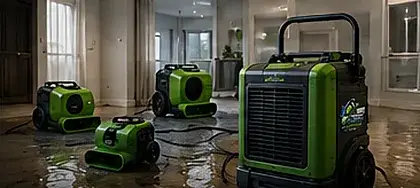
Short answer: Structural drying removes the water that soaked into drywall, wood framing, subfloor and concrete after a leak or flood. Green Choice uses commercial dehumidifiers, air movers and wall cavity drying, checks moisture readings every day and documents them for your insurance. When everything is dry, our crew repairs the drywall, floors, trim and paint. Call 516-905-5970.
Why a room that feels dry may not be
Surfaces dry first. Paint and the top of a floor can feel dry in a day while the inside of the drywall, the bottom plate behind it and the subfloor under the carpet are still wet. If walls are closed or floors are installed over wet materials, the water has nowhere to go. That is how mold, buckled floors and peeling paint show up months later.
Every material has a normal moisture level for a dry house in your area. Our job is to bring every wet material back to that level, measured with meters, not judged by touch.
How the drying works
Drying is a balance of three things:
- Air movement. Air movers blow across wet surfaces and speed up evaporation. They are aimed at the base of walls, under cabinets and across floors.
- Dehumidification. Evaporated water has to be pulled out of the air or it settles back into the materials. Our dehumidifiers are sized to the space and the amount of water.
- Temperature. Warm air holds more moisture and speeds drying. We keep the space in a good range, which is why we may ask you not to open windows on a humid summer day.
For special cases we add more tools: injection drying into wall cavities through small holes, floor mats that pull water out of hardwood, and containment with plastic sheeting to create a smaller drying chamber.
Daily moisture readings
We come back every day, usually for three to five days. Each visit we take readings at the same marked points, adjust and move equipment, and record the numbers. When the readings match dry reference points in the same house, that area is done.
This daily log is what adjusters look for. It proves the drying was needed, shows how long it took and supports the cost of the equipment days. It also protects you if a problem shows up later.
Materials we dry, and when we remove them
Drywall
Can often be dried in place after a clean water loss caught early. Removed when it soaked up gray or black water, when it is swollen or crumbling, or when the insulation behind it is wet.
Wood framing and subfloor
Almost always dried in place. Studs and plywood dry well with the right setup.
Hardwood floors
Dried with floor mats and slow controlled drying. Some cupping relaxes as the wood dries; any lasting damage is documented for repair.
Concrete and block
Dries slowly and needs dehumidification over several days. Common in Long Island basements and slab homes.
Insulation
Wet fiberglass and cellulose insulation are removed; they lose their insulating value and hold water against the framing.
Repair and rebuild
Once the house is dry, we put it back together:
- Insulation and drywall, taped, finished and painted to match
- Baseboards, door casing and trim
- Carpet and pad, laminate, vinyl plank and hardwood repair or replacement
- Kitchen and bathroom cabinet repairs where water got under the boxes
- Ceilings after upstairs leaks
One crew from extraction to final paint means you are not waiting weeks for a separate contractor, and nobody can say the other company caused the problem.
Running equipment in your home
Drying equipment is loud and uses a lot of power, and we will be honest about that. We plan circuits with you so breakers do not trip, keep cords out of walkways and use quieter units in bedrooms when we can. The equipment is safe to run while you sleep or are at work. Please do not turn it off or move it; it is set up for a reason, and every hour off adds time to the job.
Questions about this service
What does a moisture map show?
It is a drawing of the affected rooms with marked points where we take readings, the reading at each point and the date. It shows exactly where the water went, how wet each material was and how it dried day by day. Adjusters use it to approve drying, and it protects you if a problem appears later.
How long does structural drying take?
Most jobs take three to five days. Hardwood, plaster walls, concrete and thick materials can take longer. We decide by daily readings, not by the calendar.
Can I turn off the fans at night?
Please do not. Every hour the equipment is off slows the drying and can let moisture settle back into materials. If the noise is a problem, call us and we will adjust the setup.
Will the equipment raise my electric bill?
Some, yes. Keep your bills; your insurance company may reimburse the extra electricity used during drying on a covered claim.
Do you do the repairs too?
Yes. After drying, our crew handles drywall, paint, trim, flooring and cabinet repairs.