
Short answer: Green Choice removes standing water from Long Island homes and businesses 24 hours a day. We extract the water, lift or remove wet carpet and pad, measure moisture inside the walls and set up air movers and dehumidifiers until every reading is dry. Call 516-905-5970.
Why extraction has to happen first
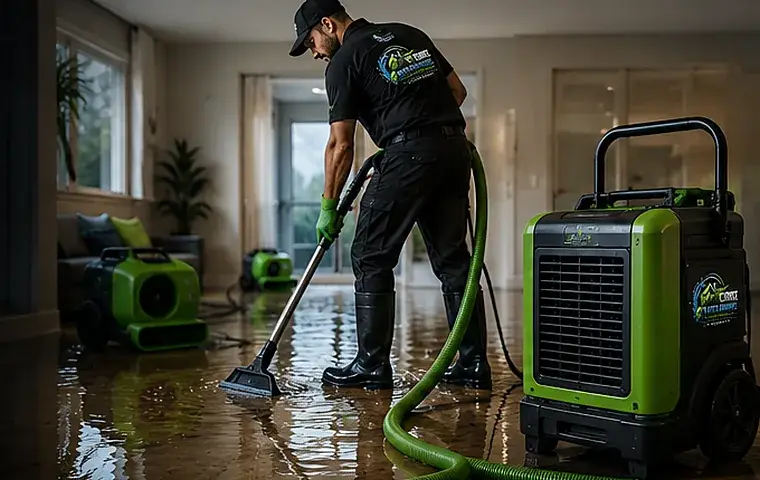
Drying equipment can only pull out the water that is left after extraction. A single inch of water across a 500 square foot finished basement is roughly 300 gallons. Fans will not move that. A proper extractor will, in a fraction of the time, and it pulls water out of carpet and pad that a wet vac leaves behind.
The faster the bulk water comes out, the less wicks up into the walls. Drywall soaks water up like a paper towel, often 12 to 24 inches above the waterline. Get the water out early and many walls can be dried in place instead of cut out and replaced.
What a cleanup visit looks like
Here is what happens when our crew arrives:
- Safety check. We confirm the water is off at the source and that wet areas are safe from live electricity.
- Find the source and the edges. We use moisture meters and a thermal camera to see how far the water went, including under cabinets and behind baseboards, where you cannot see it.
- Photos before anything moves. Your insurance company will want to see the damage as we found it.
- Extract. Truck-mounted units for big losses, portable extractors and weighted wands for carpet, squeegees and pumps for hard floors and basements.
- Decide what stays. Wet pad under carpet almost always goes. Carpet itself can often be dried and cleaned if the water was clean. Soaked particle board, insulation and swollen trim are removed.
- Set the drying system. Air movers, dehumidifiers and sometimes wall cavity drying. We leave you a written moisture map.
Carpet, hardwood, tile and basements
Wall-to-wall carpet
Green Choice started as a carpet cleaning company in 2005, so we know carpet. With clean water, we usually float the carpet, pull the wet pad, dry the carpet and subfloor, then install new pad and clean the carpet. With gray or black water, the carpet usually has to go for health reasons.
Hardwood floors
Oak and maple strip floors start cupping as the bottom of the boards takes on water. We extract with special floor mats that pull water out from between the boards, then dry slowly so the wood does not crack. Some floors come back flat. Others need sanding or partial replacement once they are dry, and we document that for the claim.
Tile, vinyl and laminate
Tile usually survives. Laminate and many floating vinyl planks trap water underneath and often have to come up so the subfloor can dry. We test before we pull anything.
Finished basements
Basements are our most common call. Water sits at the lowest point, under the carpet and behind the drywall at the bottom plate. We pump, extract, open up the bottom of the walls when needed and dry the concrete and the framing.
Why not just use a shop vac and fans?
For a small spill on tile, a wet vac is fine. For anything bigger, the problem is the water you cannot see. Water under a cabinet or inside a wall cavity stays wet for weeks behind a dry surface, and that is where mold starts. Box fans also blow moisture around the room instead of removing it from the air. A dehumidifier made for restoration pulls many gallons a day out of the air so the materials can keep releasing water.
There is also the insurance side. If you dry it yourself and the adjuster later finds mold or a cupped floor, it is hard to prove what happened. Professional moisture logs show the loss was handled right.
Commercial spaces
We also handle water losses in offices, retail stores, medical offices and warehouses. A business cannot sit closed for a week, so we plan the drying around your hours, set up containment to keep working areas open where possible, and give your property manager the documents they need. We can provide certificates of insurance to building management before we start.
What it costs
The price depends on how much water, how long it sat, which category of water it is and what has to be removed. A small clean-water leak caught early costs far less than a basement that sat wet over a weekend. You get a written estimate before work beyond the emergency stop-the-damage steps begins. When the loss is covered by insurance, we can bill your carrier directly.
Questions about this service
How much water can you remove?
There is no practical limit. Truck-mounted extractors and submersible pumps handle full basements, and portable units reach upstairs rooms and condos where a truck hose cannot.
Can my wet carpet be saved?
Often yes, if the water was clean and we get there within a day or two. The pad underneath is usually replaced because it holds water like a sponge. Carpet soaked by sewage or flood water is removed for health reasons.
Will you move my furniture?
Yes. We move furniture off the wet area or lift it on blocks and foam pads so legs do not stain the carpet or soak up water.
Do I need to be home while the equipment runs?
Someone needs to let us in for the first visit and for daily moisture checks. The equipment runs safely while you are at work or asleep.